
iReady Scale Drawing Questions and Answers for Level G (Grade 7)
i-Ready Level G (Grade 7) Scale Drawings: Practice Questions and Answers
In this page, we have added some examples of the Scale Drawing questions and answers that appear in the Level G quiz for Grade 7. Please read and understand the questions below to get a better understanding of scale drawing. The questions and answers refer to real questions that appear on the test at grade 7.
How to Solve Scale Drawing Problems
A scale compares a measurement on a drawing, map, or model to the matching measurement in real life. In other words, the scale is a relationship. It tells you how “big” real life is compared to the picture in front of you.
Most scale problems follow one simple idea: you are either going from the drawing to real life, or you are going from real life to the drawing. That direction decides whether you multiply or divide. The math itself is usually not hard, but students get stuck when they rush, mix up units, or forget what the question is actually asking.
Step 1: Identify what the scale means
Read the scale slowly, and say it out loud in a full sentence. For example, if the scale is 1 cm : 8 km, you can read it as: “Every 1 centimeter on the map represents 8 kilometers in real life.” When you can say it clearly, you are much less likely to flip the operation by accident.
Step 2: Decide whether to multiply or divide
This is the key decision. Ask yourself a quick question: “Am I trying to find the real distance, or am I trying to find the drawing distance?”
- Drawing → Real life: Multiply. The real world is larger than the drawing, so your number should usually get bigger.
- Real life → Drawing: Divide. The drawing is smaller than real life, so your number should usually get smaller.
If the scale is written like this: 1 unit on the drawing = k units in real life, then:
- Real measurement = (drawing measurement) × k
- Drawing measurement = (real measurement) ÷ k
That’s it. Short. Clear. But you still have to manage the units.
Step 3: Keep the units consistent (this is where mistakes happen)
Units are the “labels” on the numbers, and the labels matter just as much as the numbers. A lot of scale questions are designed to catch students who ignore units, especially when they see inches and feet, or miles and feet, or centimeters and meters in the same problem.
Before you do the final step, check the units in the scale and check the units in the question. If they do not match, you must convert. Sometimes you convert first. Sometimes you convert at the end. Either way is fine, as long as you do it carefully and your answer ends in the unit the question asked for.
Common unit conversions you should know
- 12 inches = 1 foot
- 3 feet = 1 yard
- 5,280 feet = 1 mile
- 1,000 meters = 1 kilometer
- 100 centimeters = 1 meter
Step 4: Solve, then do a quick “Does this make sense?” check
After you calculate, pause for two seconds and sanity-check your answer. This tiny habit saves a lot of points on tests.
- If you went from drawing to real life, your real measurement should usually be larger than the drawing measurement (unless your scale is smaller than 1, which is rare in school maps and blueprints).
- If you went from real life to drawing, your drawing measurement should usually be smaller than the real measurement.
- If you got a giant number for a drawing length (like 40 inches on a small blueprint), stop and re-check your operation and units.
Mini examples (short and realistic)
Example A: Drawing → Real life (Multiply)
Scale: 1 cm : 5 km
Drawing distance: 3.2 cm
Question: What is the real distance?
Answer: 16 km
Why: You are going from the drawing to real life, so multiply: 3.2 × 5 = 16 km.
Example B: Real life → Drawing (Divide)
Scale: 1 inch : 6 miles
Real distance: 30 miles
Question: How long is it on the map?
Answer: 5 inches
Why: You are shrinking real life to the drawing, so divide: 30 ÷ 6 = 5 inches.
Example C: Same scale, but unit conversion at the end
Scale: 1 inch : 8 feet
Drawing length: 9 inches
Question: What is the real length in yards?
Answer: 24 yards
Why: Multiply first: 9 × 8 = 72 feet. Then convert feet to yards: 72 ÷ 3 = 24 yards.
Quick checklist (what to do every single time)
- Underline what the question wants (real distance, drawing distance, scale, perimeter, or area).
- Rewrite the scale as a sentence: “1 drawing unit represents ___ real units.”
- Choose multiply (drawing → real) or divide (real → drawing).
- Convert units if needed, and make sure your final unit matches the question.
- Do a quick reasonableness check so you don’t lose points to a simple flip.
When scale drawing problems feel confusing, it is usually because the direction is unclear or the units are fighting each other. Slow down, write the scale in words, and let the units guide your steps. Once you do that, these problems become very predictable.
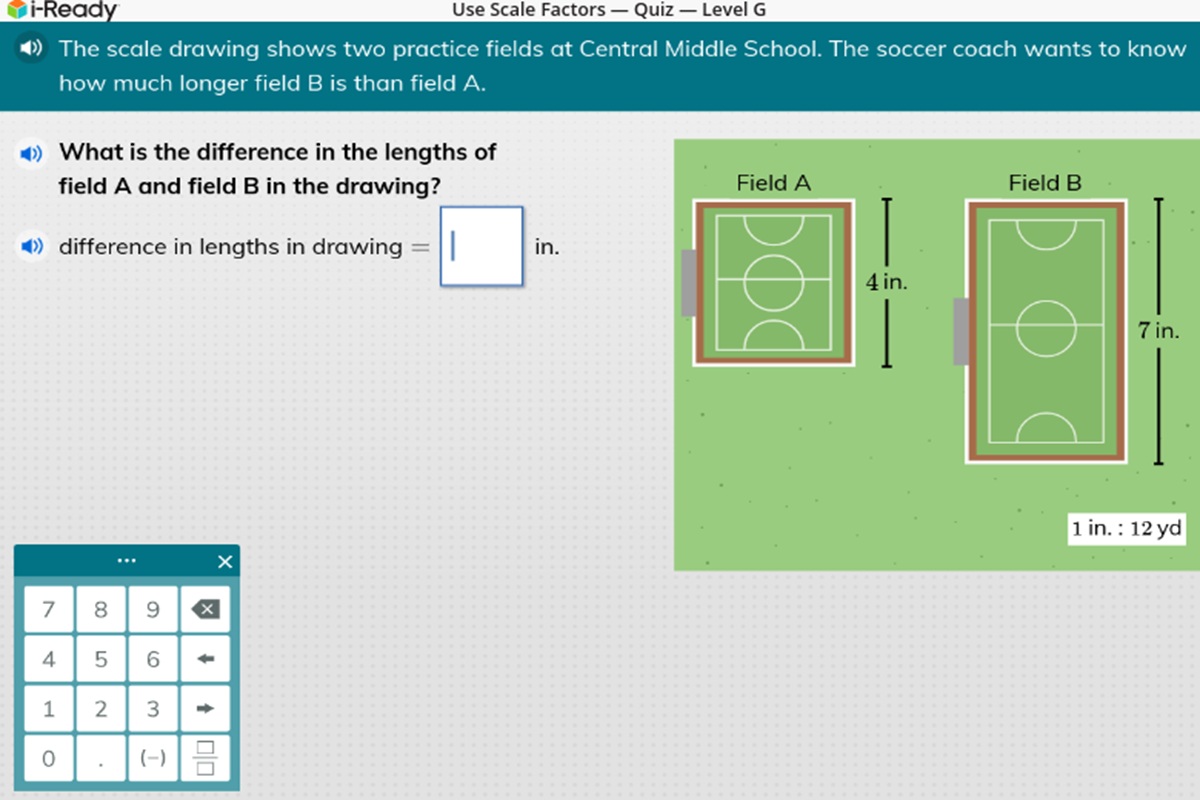
Realistic Scale Drawing Examples (i-Ready Style Practice)
Scale drawing problems show up a lot in upper-elementary and middle school math because they test two important skills at the same time: proportional reasoning and unit conversion. In the real i-Ready Diagnostic, these questions usually look simple at first, but the trick is staying calm, keeping the units straight, and thinking, “Am I multiplying because I’m going from drawing to real life, or dividing because I’m going from real life to the drawing?”
Below are practice questions written in a similar style to what students often see in Grade 6–8 scale drawing lessons. The numbers are realistic, the wording feels like an assessment, and many questions include a short reasoning check so students learn to explain their thinking, not just guess.
Section 1: Scale Given, Find Real Distance (Multiply)
Question
Jake’s map shows the distance from the Bake Stars Cafe to the restaurant supply store as 3 centimeters. If the scale of the map is 1 centimeter to 8 kilometers, what is the real distance from the shop to the store?
Answer
24 kilometers
Explanation
You multiply because you are moving from the drawing to real life. 3 centimeters × 8 kilometers per centimeter = 24 kilometers.
Question
Azul is making space for the pool table that will go in the game room. The scale drawing shows the length of the table as 2 inches. If the scale of the drawing is 1 inch to 4 feet, what is the actual length of the pool table?
Answer
8 feet
Explanation
Each inch on the drawing represents 4 feet in real life, so 2 inches × 4 feet per inch = 8 feet.
Question
A blueprint shows a hallway is 6 inches long. The scale is 1 inch to 3 feet. What is the real hallway length?
Answer
18 feet
Explanation
6 inches on the plan means 6 groups of 3 feet, so 6 × 3 = 18 feet.
Question
A model car is 5 inches long. The scale is 1 inch to 2.5 feet. What is the real car length?
Answer
12.5 feet
Explanation
You multiply the drawing length by the scale value: 5 × 2.5 = 12.5 feet.
Question
On a map, two towns are 4.5 cm apart. The scale is 1 cm to 12 km. What is the real distance?
Answer
54 kilometers
Explanation
Since 1 cm represents 12 km, 4.5 cm represents 4.5 × 12 = 54 km.
Question
A floor plan shows a room is 7 inches wide. The scale is 1 inch to 2 feet. What is the actual width?
Answer
14 feet
Explanation
Because every inch stands for 2 feet, 7 inches corresponds to 7 × 2 = 14 feet.
Question
A hiking map shows a trail segment is 6.2 centimeters long. The scale is 1 centimeter to 500 meters. How long is the trail segment in meters?
Answer
3,100 meters
Explanation
This is a straight multiply: 6.2 × 500 = 3,100 meters, and the units make sense because we are converting map centimeters into real meters.
Question
A drawing of a skateboard ramp shows the ramp is 11 inches long. The scale is 1 inch : 18 inches. What is the real ramp length in inches?
Answer
198 inches
Explanation
Each drawing inch represents 18 real inches, so 11 × 18 = 198 inches.
Section 2: Scale Given, Find Drawing/Model Distance (Divide)
Question
Luna is building a scale model of the Empire State Building for the youth center. The real Empire State Building is 1,250 feet high. If Luna is making the model at a scale of 1 foot to 250 feet, how tall will her model be?
Answer
5 feet
Explanation
You divide because you are going from real life down to the model size. 1,250 ÷ 250 = 5 feet.
Question
Mags got a scale model of a jet plane from an online auction. She looked up the real length and found it to be 65 feet. If the model’s scale is 1 foot to 5 feet, how long will the model be?
Answer
13 feet
Explanation
The model is smaller than the real plane, so divide the real length by 5. 65 ÷ 5 = 13 feet.
Question
A real swimming pool is 30 meters long. A scale drawing uses 1 cm to represent 2 meters. How long is the pool on the drawing?
Answer
15 centimeters
Explanation
Each 1 cm stands for 2 m, so 30 m ÷ 2 = 15 cm on the drawing.
Question
A real trail is 18 miles long. On a map, 1 inch represents 6 miles. How long is the trail on the map?
Answer
3 inches
Explanation
This is a divide situation: 18 ÷ 6 = 3 inches.
Question
A building is 96 feet tall. A model uses a scale of 1 inch to 8 feet. How tall is the model?
Answer
12 inches
Explanation
Divide the real height by 8 feet per inch: 96 ÷ 8 = 12 inches.
Question
A gym is 180 feet long in real life. A blueprint uses a scale of 1 inch : 15 feet. How long is the gym on the blueprint?
Answer
12 inches
Explanation
Because 1 inch stands for 15 feet, you divide 180 by 15 to find the drawing length. 180 ÷ 15 = 12 inches.
Question
A soccer field is 120 meters long. A diagram uses 1 centimeter to represent 8 meters. How long is the field on the diagram?
Answer
15 centimeters
Explanation
Divide the real length by 8 meters per centimeter: 120 ÷ 8 = 15 centimeters.
Section 3: Find the Missing Scale
Question
Vector’s map has the scale missing. Distances that are 8 miles apart are shown as 2 inches apart. What is the scale for Vector’s map?
Answer
1 inch : 4 miles
Explanation
Since 2 inches represents 8 miles, 1 inch represents half of 8 miles. 8 ÷ 2 = 4 miles per inch.
Question
On a map, 5 cm represents 40 km. What is the map scale?
Answer
1 cm : 8 km
Explanation
If 5 cm corresponds to 40 km, then 1 cm corresponds to 40 ÷ 5 = 8 km.
Question
A blueprint shows 9 inches represents 27 feet. What is the blueprint scale?
Answer
1 inch : 3 feet
Explanation
Divide both sides by 9 inches so the drawing side becomes 1 inch. 27 ÷ 9 = 3, so 1 inch represents 3 feet.
Question
A drawing shows 4 inches represents 10 yards. What is the scale?
Answer
1 inch : 2.5 yards
Explanation
Because 10 yards is spread across 4 inches, each inch represents 10 ÷ 4 = 2.5 yards.
Question
A map shows 3.6 centimeters represents 18 kilometers. What is the scale written as “1 cm : ___ km”?
Answer
1 cm : 5 km
Explanation
To find the per-centimeter amount, divide 18 by 3.6. 18 ÷ 3.6 = 5, so each centimeter represents 5 kilometers.
Question
A scale model uses 7 inches to represent 21 feet. What is the scale written as “1 inch : ___ feet”?
Answer
1 inch : 3 feet
Explanation
Both numbers can be divided by 7. 21 ÷ 7 = 3, so 1 inch represents 3 feet.
Section 4: Changing the Scale
Question
Pepper Jackie draws a map of the youth center building. What is the scale of Jackie’s map?
Answer
1 inch : 12 feet
Explanation
The scale tells you how much real distance one inch on the drawing represents, so it is written as 1 inch represents 12 feet.
Question
Pepper Jackie decides her map of the youth center is too small and redraws it so that all distances are three times larger than before. What is the scale of the new map?
Answer
1 inch : 4 feet
Explanation
When the drawing gets 3 times larger, each inch on the paper represents one-third of the real distance it used to represent. 12 ÷ 3 = 4 feet per inch.
Question
A map scale is 1 inch : 10 miles. A new map is made where distances are half as long on paper (everything shrinks by a factor of 2). What is the new scale?
Answer
1 inch : 20 miles
Explanation
If the drawing shrinks, the real world did not shrink, so each inch on the paper must represent more miles. Doubling 10 miles gives 20 miles per inch.
Question
A blueprint scale is 1 cm : 2 m. A new blueprint is made where all drawing lengths are doubled. What is the new scale?
Answer
1 cm : 1 m
Explanation
Doubling the drawing makes the paper measurements larger, so each centimeter represents less real distance than before. 2 meters per cm becomes 1 meter per cm.
Question
A scale is 1 inch : 8 feet. A student redraws the plan so every drawing length is 4 times longer than before. What is the new scale?
Answer
1 inch : 2 feet
Explanation
Making the drawing 4 times larger means each inch now covers one-fourth the real distance. 8 ÷ 4 = 2 feet per inch.
Section 5: Area Problems with Scale
Question
The game room of the youth center needs carpet. The room measures 3 feet by 2 feet on the blueprint. If the scale on the blueprint is 1 foot to 5 yards, what is the actual area of the game room?
Answer
1,350 square feet
Explanation
First scale each dimension. Length: 3 ft × 5 yd per ft = 15 yd = 45 ft. Width: 2 ft × 5 yd per ft = 10 yd = 30 ft. Then multiply: 45 × 30 = 1,350 square feet.
Question
A rectangular park is 6 cm by 4 cm on a map. The scale is 1 cm : 50 m. What is the actual area of the park in square meters?
Answer
60,000 square meters
Explanation
Convert each side using the scale. 6 cm represents 6 × 50 = 300 meters, and 4 cm represents 4 × 50 = 200 meters. The area is 300 × 200 = 60,000 square meters.
Question
A room is 8 inches by 5 inches on a floor plan. The scale is 1 inch : 2 feet. What is the actual area in square feet?
Answer
160 square feet
Explanation
Scale both dimensions before multiplying. 8 inches represents 16 feet, and 5 inches represents 10 feet. Area = 16 × 10 = 160 square feet.
Question
A garden is drawn as 3 cm by 9 cm. The scale is 1 cm : 4 m. What is the real area in square meters?
Answer
432 square meters
Explanation
Convert the sides first: 3 cm → 12 meters and 9 cm → 36 meters. Then area = 12 × 36 = 432 square meters.
Question
A stage is shown as 4.5 inches by 3 inches on a plan. The scale is 1 inch : 6 feet. What is the real area of the stage in square feet?
Answer
4,860 square feet
Explanation
Convert each side using the scale: 4.5 inches → 4.5 × 6 = 27 feet, and 3 inches → 3 × 6 = 18 feet. Area = 27 × 18 = 486 square feet. Wait carefully: 27 × 18 = 486 (not 4,860). The correct area is 486 square feet.
Answer (Corrected)
486 square feet
Section 6: Multi-Step Unit Conversion Scale Problems
Question
A map shows two cities are 7 cm apart. The scale is 1 cm : 15 km. What is the distance in meters?
Answer
105,000 meters
Explanation
First find the real distance in kilometers: 7 × 15 = 105 km. Then convert kilometers to meters: 105 km = 105,000 meters.
Question
A blueprint shows a wall is 9 inches long. The scale is 1 inch : 30 centimeters. What is the real length in meters?
Answer
2.7 meters
Explanation
Each inch represents 30 cm, so 9 inches represents 9 × 30 = 270 cm. Since 100 cm equals 1 meter, 270 cm equals 2.7 meters.
Question
On a map, a trail is 3.5 inches long. The scale is 1 inch : 8 miles. What is the real length in feet?
Answer
147,840 feet
Explanation
First find the real distance in miles: 3.5 × 8 = 28 miles. Then convert miles to feet: 28 × 5,280 = 147,840 feet.
Question
A diagram shows a river is 12 centimeters long. The scale is 1 cm : 0.4 km. What is the real river length in meters?
Answer
4,800 meters
Explanation
First convert to kilometers: 12 × 0.4 = 4.8 km. Then convert kilometers to meters: 4.8 km = 4,800 meters.
Section 7: i-Ready Style “Check Your Reasoning” Questions
Question
A student says: “If the scale is 1 inch : 4 feet, then 6 inches is 24 feet.” Is the student correct?
Answer
Yes, the student is correct.
Explanation
The scale means each inch corresponds to 4 feet, so multiplying 6 × 4 gives 24 feet. This is a reasonable answer because the drawing distance is bigger, and the real distance should be bigger by the same factor.
Question
A student says: “If I double the size of the drawing, the scale should be 1 inch : 24 feet instead of 1 inch : 12 feet.” Is the student correct?
Answer
No, the student is not correct.
Explanation
When you double the drawing, the drawing gets larger, so each inch represents less real distance than it did before. The scale should change from 1 inch : 12 feet to 1 inch : 6 feet because 12 ÷ 2 = 6.
Question
A student finds an area by scaling only one side of a rectangle. Why is that incorrect?
Answer
Because area depends on two dimensions, not one.
Explanation
Area comes from multiplying length and width, so you must convert both dimensions into real-life measurements before multiplying. If you scale only one side, you are no longer representing the same rectangle, and your final area will be wrong even if one of your conversions was correct.
Question
A student is working with a scale of 1 cm : 10 m and says, “Since 10 is bigger than 1, I should divide when I see a map length.” Is that always true?
Answer
No, it is not always true.
Explanation
Whether you multiply or divide depends on the direction you are converting, not on which number looks bigger. If you are going from the drawing to the real world, you multiply, and if you are going from the real world to the drawing, you divide.
Section 8: Extra Practice (Quick Answer Style)
Question
A map scale is 1 cm : 6 km. A road is 9 cm on the map. What is the real distance?
Answer
54 kilometers
Question
A model uses 1 inch : 9 feet. The real object is 63 feet long. How long is the model?
Answer
7 inches
Question
A blueprint shows a classroom is 10 inches by 7 inches. The scale is 1 inch : 3 feet. What is the real perimeter?
Answer
102 feet
Explanation
Convert first: 10 inches → 30 feet and 7 inches → 21 feet. Then perimeter = 2(30 + 21) = 102 feet.
Question
A map shows 2.25 inches represents 9 miles. What is the scale?
Answer
1 inch : 4 miles
Explanation
Divide both sides by 2.25. 9 ÷ 2.25 = 4, so 1 inch represents 4 miles.
Question
A diagram uses a scale of 1 cm : 25 m. A rectangular garden is 8 cm by 5 cm on the diagram. What is the real perimeter in meters?
Answer
650 meters
Explanation
Convert each side: 8 cm → 200 m and 5 cm → 125 m. Perimeter = 2(200 + 125) = 650 meters.
Question
A floor plan uses 1 inch : 2.5 feet. A wall measures 14 inches on the plan. What is the real wall length in feet?
Answer
35 feet
This page provides original practice problems written in the style of Grade 6–8 scale drawing lessons. It does not reproduce copyrighted i-Ready assessment items.